
The Fall and Rise of CO2 as a Refrigerant
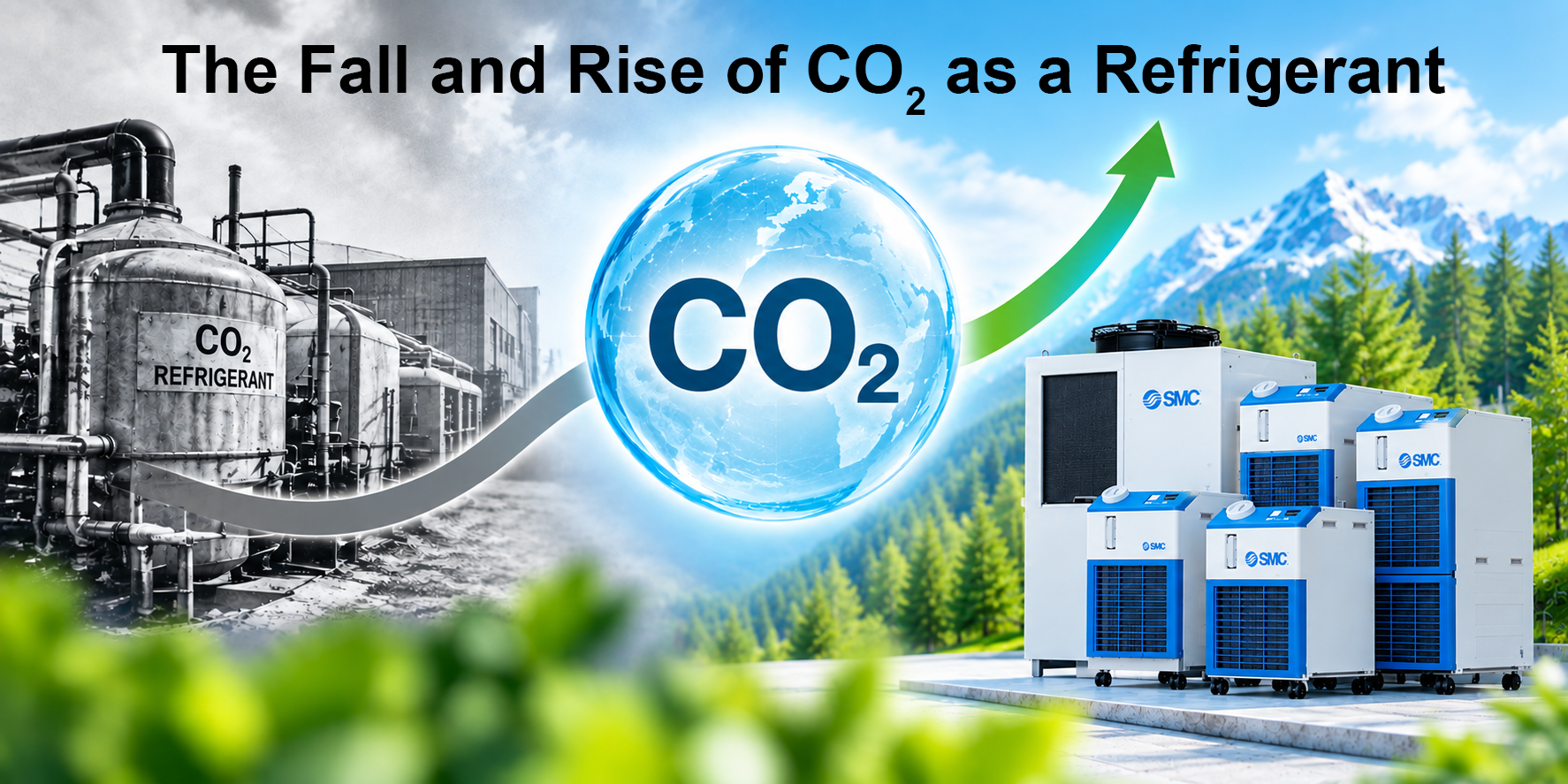
CO2 is Inked Out Virtually Overnight in the 1930s
In 1937, Thomas Midgley Jr. stood in front of The Chemists' Club in New York City and took a deep breath of Freon into his lungs. Then he slowly exhaled the chemical into a jar containing a lighted candle, demonstrating to the audience that the chemical was not poisonous and would not burn. The reason this demonstration made such an impression at the time stemmed from the commonplace, and sometimes harrowing, industrial accidents caused by using highly toxic, reactive gases like ammonia and methyl chloride for industrial cooling.
Accounts of explosions caused by ammonia concentrators litter American newspapers in the late 19th and early 20th century. One of the worst of these occurred at the Jacob Ruppert Brewery in Manhattan on June 28, 1912 when a compressor head blew out in the refrigeration plant, spreading ammonia fumes out in a four block radius and killing two engineers; one who was blown 100 ft through an open door and one who died from inhaling ammonia fumes.
It wasn’t that there were no safer choices for “artificial refrigeration” in the early 1900’s. Non-toxic, non–explosive CO2 had been in use as a coolant since the mid-1800s; however, its low critical point and high operating pressure made it expensive to use with the technology of the time. Companies were faced with the perennial tradeoff between safety and cost. CO2 cooling was widely adopted for marine refrigeration and high-density public places where safety was paramount. However, breweries and food processing plants didn’t have the margins to install CO2 compressors, so they had to build facilities in rural areas where an ammonia leak wouldn’t impact a large number of people.
Things came to a head in Chicago during the summer of 1929 with a series of methyl chloride leaks that sickened 29 people, killing ten of them. Headlines like "1 Dead, 2 Ill; Suspect Gas in Refrigerator", "OFFICIAL BLAMES METHYL CHLORIDE FOR FOUR DEATHS", and "REFRIGERATORS USE DEADLY GAS - Mysterious Deaths in Chicago Attributed to Lethal Fumes" caused panic; which directly led to Midgley and his team being tasked with finding an alternative and, less than a year later, synthesizing dichlorodifluoromethane — rebranded as Freon.
Freon was an inflection point. It became the golden ticket to inexpensive cooling, kick-starting the refrigeration boom of the mid-20th century. Almost overnight, it created new multi-billion dollar industries, such as supermarkets, frozen food, and residential air conditioning, that couldn’t safely exist before. Despite its large industrial footprint, CO2 became unnecessary and vanished from the market less than a decade after the introduction of Freon.
A stop-action frame of American industry in 1930 would have caught the business world suspended for an instant at the very beginning of a 180° turn, casting aside CO2 as a refrigerant and embracing the future. This would be the state of affairs for the remainder of the 20th century.
Freon’s Hidden Poison Pill
Freon, the “Kleenex” of chlorofluorocarbons (CFCs), completely reshaped 20th century life in the 50 years between 1935 and 1985. In 1935, a middle class family living in a Sears catalog home would have kept their food cold with an icebox, opened the windows and turned on a fan when it was hot, swatted bugs with a newspaper, and had bench seats in their car. By 1985, synthetic fluorocarbon refrigerants like Freon had given the average middle class family a home with an electric refrigerator/freezer, central air-conditioning, and aerosol bug spray on the shelves. They drove a car with climate control and comfortable polyurethane foam seating.
Manufacturers reaped the benefits of Freon as well. Process cooling became much easier and much more affordable, especially as reciprocating compressors replaced vertical compressors and stainless steel replaced cast iron and carbon steel in industrial chillers. Freon, otherwise known by the ASHRAE refrigerant designations R-11, R-12, R-22, and R-23, was a commonly used chiller refrigerant into the 1990s.
However, unbeknownst to the millions of people who were benefitting, and the companies that were becoming prosperous, from synthetic fluorocarbon refrigerants; the CFCs that were being released into the atmosphere on a daily basis were severely thinning the ozone layer over Antarctica each spring. They drifted up into the stratosphere where solar radiation broke them apart, releasing chlorine atoms that destroyed ozone molecules. The phenomenon was discovered in 1974 and demonstrated conclusively in 1985, leading to the Montreal Protocol in 1987, the first and only universally ratified treaty in the history of the United Nations. All 197 participating countries agreed to phase out classic Freon.
Save the Ozone Layer
While Freon gave us a safer and more modern world, the second order effect was damage to the Earth’s ozone layer. With unprecedented international cooperation, CFCs were phased out in favor of hydrofluorocarbons, an organic compound that contains carbon, fluorine, and hydrogen atoms, but no chlorine. Chemists realized that if they left some hydrogen atoms on the carbon chain and removed the chlorine entirely, the molecules would still work as refrigerants but would break down before reaching the ozone layer.
It worked as intended. The ozone layer is on track to fully recover to 1980 baseline levels by around 2040 globally, 2045 over the Arctic, and the late 2060s over the Antarctic. But it wasn’t long before scientists discovered that HFCs had their own second order effect: greenhouse gases. Because HFCs are remarkably stable, they can linger in the lower atmosphere for decades. Instead of letting Earth's natural infrared heat escape into space, their chemical bonds absorb the outgoing warmth and trap heat in the atmosphere.
HFCs have a global warming potential (GWP) that is thousands of times higher than carbon dioxide. Tetrafluoroethane (R-134a) and Puron (R-410A), which replaced R-11 and R-22 have a GWP of 1,430 and 2,088 respectively, compared to CO2 which has a baseline GWP of 1. In 2016, based on this information, the international community updated the Montreal Protocol with the Kigali Amendment, targeting an 80-85% reduction in HFC consumption by the late 2040s.
CO2 Comes Back, Stronger Than Ever
When the Kigali Amendment to the Montreal Protocol was adopted, and businesses were required to use long-term, climate-safe alternatives, CO2 emerged as a prime candidate due to its ideal environmental profile. It has an ODP of 0 and a baseline GWP of 1, and has been able to capture market share because it doesn’t create the safety hazards of other natural options.
Historically, CO2 has not been a viable alternative in warm climates because it has a low critical temperature of 31.1°C. When the temperature of the air exceeds that, older systems couldn’t condense the gas normally and had to run in a transcritical cycle, which made them very inefficient. Since 2016, engineering has developed advanced technologies that have allowed CO2 to return to commercial systems as an ideal, future-proof natural option at a price point that industry can absorb.
SMC’s Story
SMC began its history in the 1950s as a pneumatics automation company. Through excellent support of the semiconductor industry, SMC was given many opportunities to develop products beyond pneumatics solutions. In addition to desktop chillers with electronic Peltier cooling elements for laboratory applications, refrigerated chillers were first introduced between 2003 and 2006. These chillers were initially made-to-order designs for specific customers and applications. However, wider applications were known, so standardized products were introduced.
Without any international regulations, a variety of HFCs were employed, including R134a (GWP = 1430), R407C (GWP = 1774), and R404A (GWP = 3922). By 2010, R410A (GWP = 2088) began being used on 4kW and higher capacity chillers. While having a higher GWP than R407C, R410A offered higher energy efficiency, better heat transfer, and simpler replenishment following a leak repair stemming from its consistent composition.
Between 2009 and 2022, SMC broadly expanded its chiller product line, including larger capacities, high-efficiency units with electronic inverters on rotational components, rack mounted units, and dual circuit laser chillers. These chillers were largely filled with 410A, with a small number of exceptions using other refrigerants.
The EU initiated the earliest adoption dates for HFC phase-outs called for in the Kigali Amendment to the Montreal Protocol. The initial compliance was set for January 1, 2020 with a GWP ceiling of 2500. 410A was acceptable, but R404A was not. This prompted a lower GWP refrigerant option for SMC’s HRZ chiller series, primarily developed for the semiconductor industry. This option replaced R404A with R410A. HRZ models using R404A were phased out by December 2021, regardless of where they were shipped globally.
The EU, Canada, and the United States continued to issue regulations through their environmental protection agencies, but with different effective dates and grace periods. Other global regions have not yet followed. Nevertheless, SMC is a global supplier of chillers, so its products must meet regulations across all nations. Industrial chillers sold in Canada must meet a GWP level of 750 from January 1, 2025. The United States GWP ceiling is 700 for industrial chillers, from January 1, 2026. The EU limit is 150 for chillers up to 12kW, from January 1, 2027.
SMC now offers three refrigerants with sufficiently lower GWP to meet various regulations. R-32 (GWP = 675) has been chosen for higher capacity and higher efficiency chillers, while R454C (GWP = 145) has been chosen for others. CO2 offers the lowest GWP = 1. These chillers began to be introduced in 2024 and will continue to develop through at least 2027.
SMC chose to develop CO2 chillers for multiple reasons. First, with a GWP of 1, customers will face no further regulations. A customer can specify this type and be assured that they will be compliant now and in the future as either a facility operator or a larger equipment manufacturer. Next, CO2 offers the halo effect of having the lowest GWP. It is not considered toxic but is natural. Leaking equipment is not hazardous. Equipment manufacturers can promote themselves as the most conscientious amongst their competitors when using CO2 refrigerants. Finally, CO2 is not flammable, while many other alternatives are at least mildly flammable. This is a safety benefit and permits air freighting the chiller. These advantages have proven to be highly desirable for most customers.
The challenges of CO2 include that it must operate at a higher pressure than other refrigerants. This increases the energy consumption of the compressor and requires all refrigerant carrying components to have the strength to withstand those pressures. Additionally, it performs differently from other refrigerants, presenting different engineering considerations. The design is more complex from the standpoint of size and weight, material selection, controls, energy requirements, and performance. This required more focus and effort to achieve similar performance in a familiar package to existing customers as well as to offer in the competitive marketplace. Finally, most chiller manufacturers buy compressors and other components from other manufacturers, so cost and availability come into play for all choices. CO2 is less commonly chosen by SMC’s competitors, so those components are less commercially available. All of these factors ultimately present a higher cost, but the advantages offered are still quite welcomed.
What is CO2 refrigerant and how does it work?
- CO2 is a naturally occurring gas, also known by its chemical name, carbon dioxide. It’s a stable molecule made of one central carbon atom double-bonded to two oxygen atoms. It is clear, invisible, and odorless. It persisted in the atmosphere at about 0.028% concentration until the mid-18th century but has increased to about 0.043% due to global industrial activity, as a byproduct of many industrial activities including burning of fossil fuels for energy and deforestation. In higher concentrations it displaces oxygen and can lead to health problems. It is also a greenhouse gas, letting visible light pass through but trapping infrared heat radiation, leading to higher global temperatures. However, since it already exists naturally, and has relatively fewer harmful properties than synthetic refrigerants, it is much safer environmentally.
- As a refrigerant, it follows a standard vapor-compression cycle but requires higher pressure and is more sensitive to ambient temperatures. Existing systems cannot be retrofitted. Instead, a new chiller has to have components and software that manage the higher pressure and the unique characteristics of CO2’s pressure-enthalpy curve in various ambient temperatures.
Advantages and disadvantages of CO2 as a refrigerant
- Advantages include ease of manufacturing, wide availability, lower cost per pound, non-flammable, non-toxic, non-corrosive, single component makes recharging easier, molecular stability has low potential for decomposition, natural responsiveness to the vapor-compression refrigeration cycle, high efficiency, low GWP value serving as the reference for all others, 0 ozone depletion potential.
- Disadvantages include the requirement of higher operating pressures, higher capital costs for components, lower efficiency in warmer climates, and sensitivity to water contamination.
Is CO2 a safe refrigerant for commercial refrigeration?
- Environmentally, CO2 is the safest refrigerant because it also exists naturally in the atmosphere. It is not charged to levels high enough to cause an asphyxiation risk if leaked from its chiller. It is non-flammable, non-toxic and non-corrosive. While it does operate at a higher pressure, all the chiller’s components are designed to handle that pressure, minimizing safety risks. All industrial operators face workplace safety risks that require training. A CO2 chiller does not present an abnormally higher risk compared to other workplace hazards.